
Philadelphia Previous Residents by Era
The strongest trail changes with the date. Recent property documents point to title holders, address directories can identify a listed party, and census schedules give a household snapshot at intervals. Philadelphia’s deep records are divided among the Department of Records, City Archives, and Free Library collections, so an old address often needs more than one access channel.
| Source | Years it covers | Where held | What it shows |
|---|---|---|---|
| Philadox property documents | 1974 to present | Department of Records online portal and copy service | Modern deeds, parties, dates, document numbers, and title clues |
| City Archives deeds | 1683 to 1955 | Philadelphia City Archives | Historical ownership instruments; search and copy method varies |
| City directories | 1785 to 1935/36, with gaps | Free Library, City Archives, and Historical Society holdings | Listed name, address, occupation, and volume-specific context |
| Address and reverse directories | 1927 to 1969; 1973 to 2007 | Free Library microfilm | Address-to-listed subscriber clues, with publisher limits |
| Building permits and plans | 1889 to 1986; stated Atlas/L&I activity from 2006 | City Archives; Atlas and L&I | Building and alteration chronology, not a household roster |
| Federal census | Decennial 1790 to 1930, except 1890 | NARA and State Archives research channels | Household snapshots, not a continuous address index |
Start with the source closest to the date in question. A modern title question begins at the parcel and document index. A twentieth-century household question may begin with an address directory. A nineteenth-century house history normally needs the address conversion, city directories, maps, deeds, and archive services used together.
Note: The cover year of a Philadelphia directory commonly reflects the preceding year, so cite both the volume year and the evidence date.
Philadelphia Previous Residents Start at the Parcel
For previous residents, the present parcel is a control point, not a conclusion. Search the known address in the Philadelphia Property App and save the official property address, OPA account number, Department of Records map identity, displayed owner field, and sales-history clue. The public app accepts a street address, OPA account number, DOR map-registry number, map click, radius, drawn boundary, or a block: query. It intentionally does not search by owner name.
Next, use Atlas to confirm the parcel’s map position and navigate its property, deed, permit, zoning, historic-imagery, and map-resource links. This is especially helpful if a lot was split, consolidated, or given a different street form. The account and map identifiers can anchor the same physical place while the printed address changes.
The Property App can show City-described ownership, sales history, value, and physical characteristics. Those fields support a title lead, but they do not establish who occupied the home. A mailing address shown on a particular parcel record is correspondence information, not automatic proof of residence.
Philadelphia Previous Residents at 1974
The key Philadelphia dividing line is 1974. The Department of Records says Philadox searches deeds and other property records from 1974 to the present, with document information and watermarked copies online and printing through stated subscription access. It is the place to begin after the current parcel or sales field identifies a recent transfer.
When a chain reaches an earlier transfer, the custodian and method change. City Archives lists Philadelphia County deeds from 1683 to 1955 and mortgages from 1736 to 1963. The overlap does not make the trail continuous or fully online. For a known document reference, the Department’s copy channel can be reached at 215-686-2292 or deedcopy.info@phila.gov; for archival work, retain the parties, date, legal description, deed series, book, and page.
Philadelphia’s deed trail begins in 1683, while its city-directory run begins in 1785. That depth is valuable, but it also explains why a house history moves across modern search screens, archival indexes, image sequences, and library holdings rather than through one complete database.
Trace Philadelphia Previous Residents Through Deeds
A backward chain follows title, not occupancy. Begin with today’s parcel record and then walk each recorded conveyance back through the people who acquired and transferred the property. Keep a table of the document number, recording date, grantor, grantee, legal-description language, source, and any uncertainty. That record log is the best protection against attaching a similar name to the wrong Philadelphia property.
- Use the current OPA parcel and sales-history clue to locate the latest purchase or relevant instrument in Philadox.
- Capture the deed’s grantor, grantee, recording date and number, then compare its legal description with the selected parcel.
- Search the seller as a grantee to find the earlier acquisition. Search the buyer as a grantor when looking for the later disposition.
- Repeat the sequence one document at a time. Do not assume that a party-name hit, estate, trust, or business record identifies a single household.
- At the modern cutoff, use the City Archives and the historic land route rather than treating a Philadox no-result as the end of the chain.
- Grantor
- The party transferring an interest in the deed being examined.
- Grantee
- The party receiving that interest. In a backward search, the former owner is often found by locating the seller’s earlier grantee transaction.
- Chain of title
- A documented sequence of property transfers, linked by parties and description rather than by a street number alone.
- Legal description
- The lot, registry-map, or premises language that can connect a deed to land despite a changed address or subdivision.
Philadelphia Previous Residents Historic Land Route
The Department’s historic deed guide adds a precise route before the modern index. Its free Historical Index is a scanned Philadelphia County grantor-grantee index covering 1683 to 1977. Record the indexed surname and given name, opposite party, recording date, deed-book series, book, and page. Those details make the next request reproducible.
The historic land portal uses Recorder Initials, Book, and Page to retrieve the related subscription image sequence. The portal describes digitized deed images from 1683 to 1974 and more than 95 percent of available material, not complete coverage. Retain the year and series because book and page pairs can recur.
Sheriff deed books after 1852 are a stated exception. City Archives court sheriff books and indexes cover 1736 to 1905, and the Pennsylvania Supreme Court Eastern District holds a separate sheriff-book range. This is why a missing result may point to a different series, not a break in the property’s history.
Philadelphia Previous Residents and Old Addresses
Historic street and number changes can make a clean deed or directory trail appear to vanish. The Philadelphia Historic Streets Index connects historic and current names through City Archives road records, docket books, jury decisions, and surveys. The 1854 consolidation also created a numbering break, so an older number should not be forced into a modern search without a documented conversion.
The Free Library’s 1898 and 1910 city-directory conversion tables are a second bridge. Preserve the historic address exactly as printed, note the conversion source, and retain the current OPA address separately. A property can have a historic street label, a later number, a current situs address, and a lot or registry-map description that all need to be compared.
Old street forms are especially important in Center City and the older river wards. Neighborhood labels are useful orientation clues, but they are not a substitute for the official OPA address or the land description used in a Philadelphia deed.
Philadelphia Previous Residents in Directories
Title holders are only part of a past-residents question. The Free Library directory guide identifies address telephone directories for 1927 to 1969 and Cole’s Cross Reference and Reverse Directory for 1973 to 2007. Cole’s places streets alphabetically and addresses numerically, usually with a listed name, phone number, and length at that address. These are listed-party clues, not complete household counts.
For the earlier period, Philadelphia city directories were published from 1785 to 1935/36 according to the holder’s description, with gaps. An entry generally gives a name, listed address, and occupation. The collections, publishers, and volume gaps belong on the Philadelphia city directory page; for this backward trail, use the right volume as a dated household lead.
- Choose a directory year just before or after the event being researched, remembering that the printed volume usually reflects the prior year.
- Record the name as printed, exact address, occupation, publisher, volume year, page or image, and spelling variants.
- Check an adjacent directory year or an address telephone or reverse volume for continuity at the same street number.
- Pair the documented listing with the nearest federal census schedule, keeping the census date separate from the directory’s coverage.
- Mark the 1890 census as a real gap. It was destroyed, so a directory or newspaper can support research but cannot replace that missing enumeration.
Philadelphia Previous Residents House Timeline
Maps and permits date the place, not the person. City Archives holds permits and plans from 1889 to 1986, with no index for 1889 to 1905. Atlas and L&I supply a stated current and modern permit trail from 2006. A permit can identify a contractor, applicant, agent, owner, or organization, so compare it with the deed and directory evidence before making any connection to previous residents.
The Free Library’s house-history guide brings together the local directory, map, archive, and property approach for a Philadelphia address.
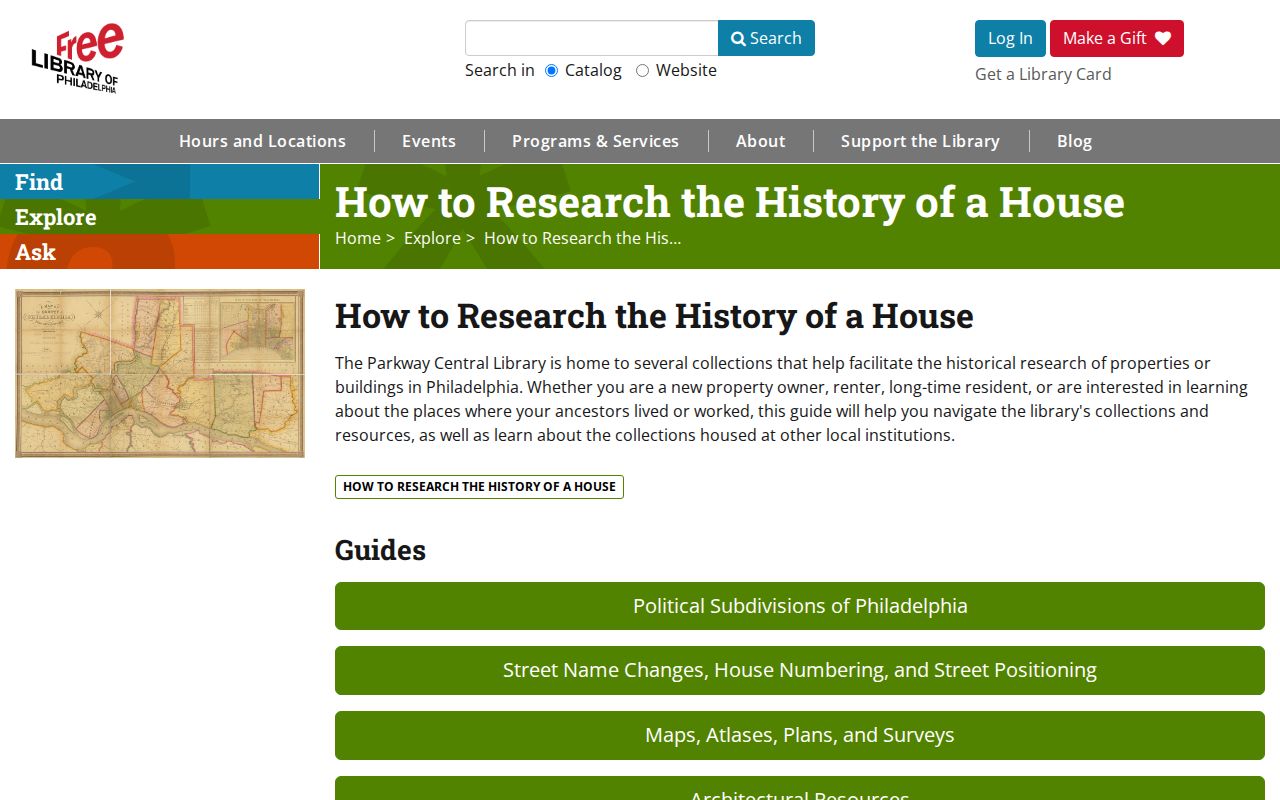
The guide is a useful reminder to build a source ladder. A Hexamer or Sanborn map can show a building footprint, materials, use, and street context, while a permit can date alteration. Neither source identifies every person who lived there.
Hexamer coverage begins in the 1850s and the series merged with Sanborn in 1915. Library of Congress examples include a 1916 Philadelphia Sanborn volume. Put the map publication condition beside the directory and deed dates rather than turning a map date into a move date.
Philadelphia Previous Residents Trail Endpoints
When a likely past household disappears from a directory, use event records to test the timeline. The Register of Wills maintains estate and probate files, wills, and inventories. Its probate request route asks for the decedent’s complete name and other identifying details, and the published mail research fee is $20. A probate file can identify an estate representative or transfer context. It does not prove residence at every address associated with the name.
Obituaries, cemetery returns, newspapers, and the City Archives vital-record group can provide further dates and relationships. City Archives reports births and deaths from 1860 to 1915 and marriage records from 1860 to 1915, while later state records follow different access rules. Match a death date, estate record, and last directory appearance cautiously before closing a Philadelphia past-residents trail.
A naturalization file can also supply a legal name or timing clue. City Archives has records from several Philadelphia courts, but such a file should still be matched to the address, directory, census, or deed evidence before it is assigned to a household.
Philadelphia Previous Residents Limits
A house history cannot prove every occupant. Directories capture publisher listings and phone-subscriber context; deeds document title; maps and permits describe a place or project. Protected address programs, sealed records, driver information, utility accounts, and private delivery data are not a public supplement to those historical sources. A no-result should never be treated as proof that a person had no connection to Philadelphia.
Philadelphia historical work also has genuine gaps. Free Library holdings do not include every directory year, and no Free Library copies are listed for 1928 or 1931 through 1934. The 1890 federal census was destroyed. Keep the gap visible in the research notes and use a distinct source only for the fact it can support.
Lawful use. Philadelphia previous-resident research is for house history, family history, estate questions, and personal curiosity. Do not use a historical address trail to track, harass, stalk, intimidate, or harm a living person; Pennsylvania law prohibits harassment and stalking.