
Finding Philadelphia Residents by Starting Detail
Start with the record keyed to the detail in hand. A current street address belongs in the Office of Property Assessment tools and Atlas. A deed date, document number, or party name belongs with recorded land records. A docket number belongs in the court system, while a marriage date or a decedent's full name belongs with the Register of Wills. For an old household, the Free Library's directories and the City Archives are often more useful than a modern portal. Each source proves only its own narrow fact.
Philadelphia is both a city and a coterminous county, so several core custodians sit within the same municipal system. That convenience does not turn them into one master roster. A parcel holder may not be the person who lives there. A docket party may share a name with someone else. An old directory entry records a listing, not every person in a household. Keep the identifying number, date, address form, and source together as the search moves between offices.
- For a current address, enter it in the Property App or Atlas and save the OPA account or Department of Records map number.
- Use a sale date, document number, or party name to inspect the recorded-document trail in Philadox when the record falls within its online range.
- For a name tied to a court matter, use the UJS docket number or narrow the participant search by court, county, and dates.
- For a past household, compare nearby city-directory years, address telephone books, or Cole's reverse directory before treating a listing as a move date.
- When an existing City record is not posted, make a written Pennsylvania Right-to-Know Law request for the identified record and time range.
Note: A no-result can reflect a private, protected, restricted, unlisted, or differently indexed record rather than an absence of the person.
Philadelphia Offices Behind Resident Records
Philadelphia's Department of Records records land documents and administers City Archives. The Office of Property Assessment keeps the parcel layer, while Atlas connects an address to City map and service records. The Register of Wills holds marriage-license and estate channels. City Commissioners administer voter registration and elections. These offices answer different questions, so a Philadelphia residents directory search stays more accurate when the record type, not a broad name search, decides the next stop.
Philadelphia Department of Records
City Hall, Room 156
Philadelphia, PA 19107
215-686-2262
Office of Property Assessment
Property account and parcel inquiry
Philadelphia, PA
215-686-4334
Official parcel search
Philadelphia Voter Registration Office
520 N. Columbus Boulevard, 5th Floor
Philadelphia, PA 19123
215-686-1591
The Department separates active-copy work from archival research. OPA and Atlas are address-led, while the elections channel handles registration under a controlled process. That division protects against using one office's result as proof of a different fact.
The Philadelphia Register of Wills is the official marriage and estate-record channel.
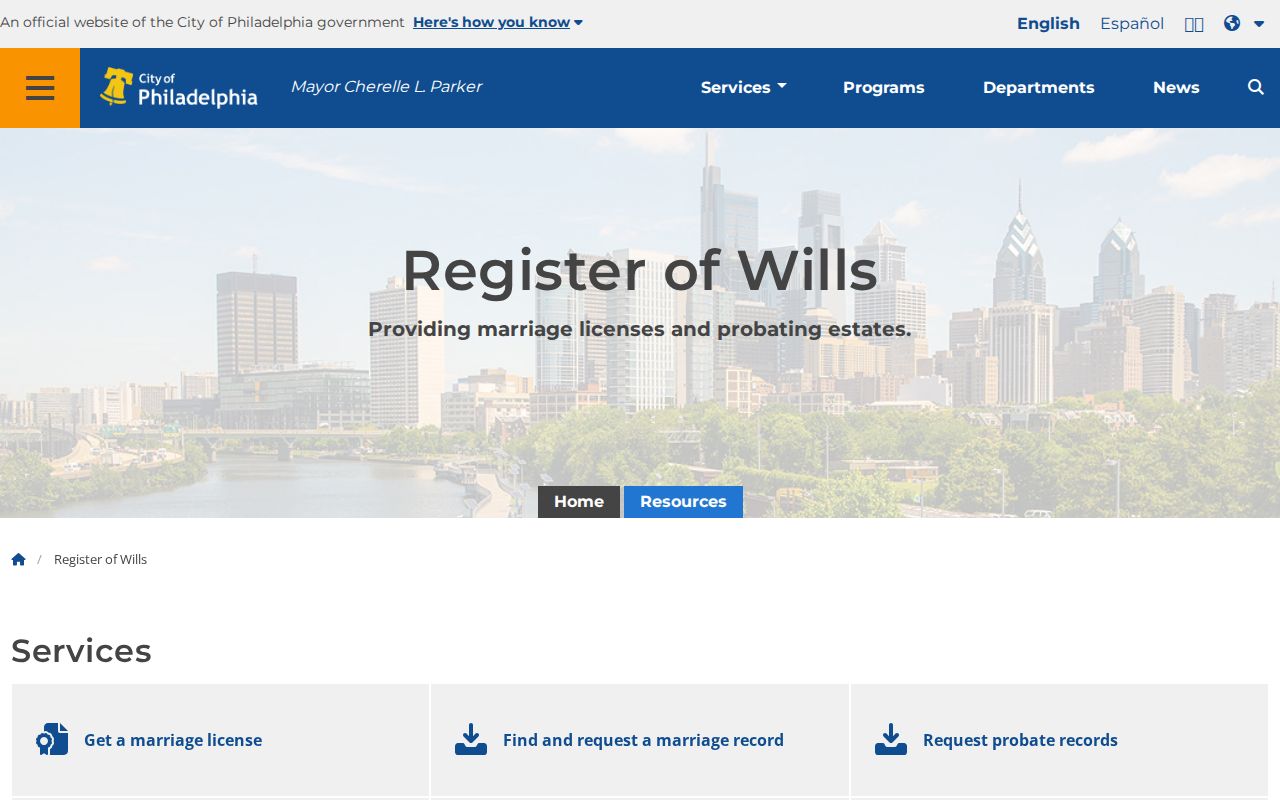
It separates event and probate records from current-address evidence.
Philadelphia Property App Starts With an Address
The Philadelphia Property App is the main current parcel starting point. It documents ownership, sales history, value, and physical characteristics, but its search is deliberately address-first. Enter a street address, property account number, or Department of Records registry map number. A block query, map click, 250-foot radius, and drawn boundary can expand the view from one parcel to nearby properties. The City removed owner-name searching for privacy, so a name alone cannot produce a citywide owner list.
| Philadelphia Property App field | Input type | Required | Use and boundary |
|---|---|---|---|
| Property information | Autocomplete text | No | Address, property account number, or Department of Records registry map number. |
| Block search | Text syntax | No | Put block: before an address to retrieve properties on that block. |
| Map selection | Map control | No | Select one visible property and inspect its record. |
| Radius or boundary | Spatial control | No | Choose a 250-foot radius or draw a shape around properties. |
| Owner name | Unavailable field | Not applicable | Owner-name searching was removed; an assessed owner is not proof of occupancy. |
The Philadelphia Property App shows the City’s address, account, and map-registry entry choices before a parcel is selected.
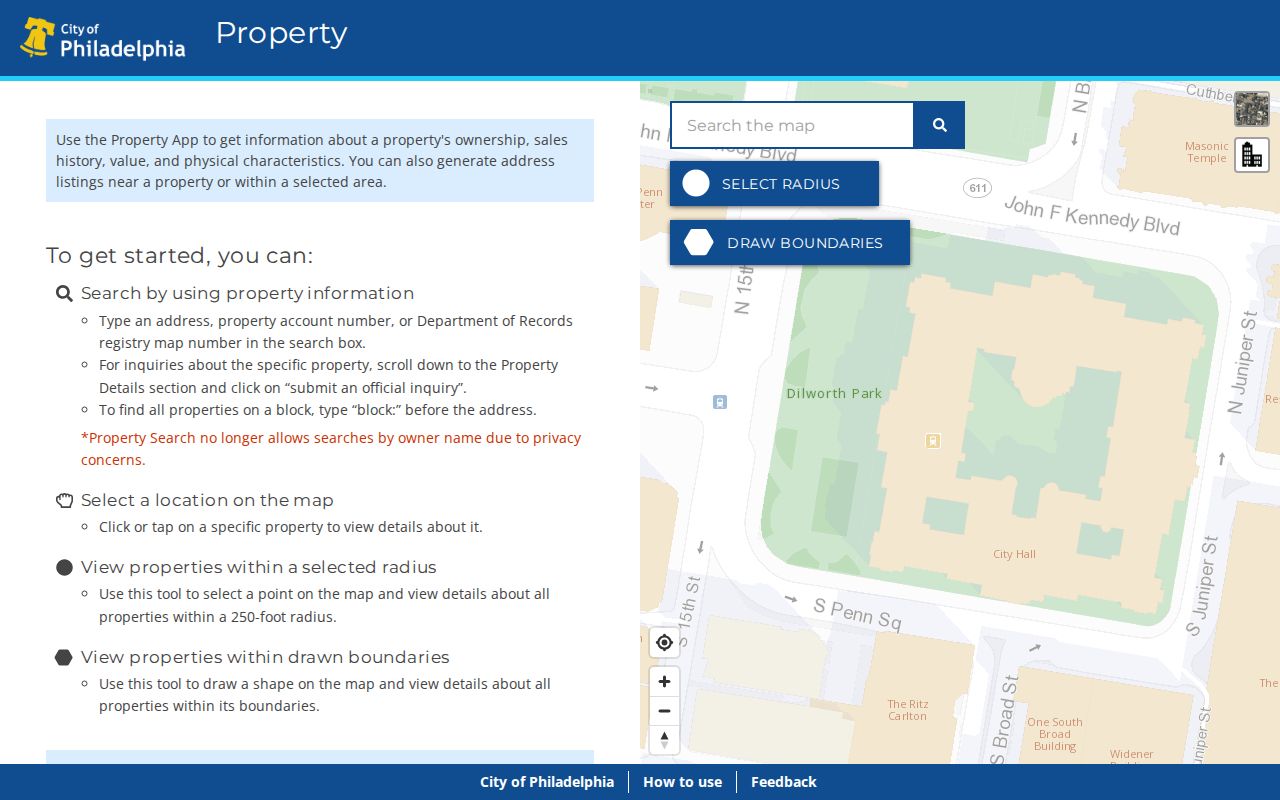
Use a displayed owner as assessment evidence only. Record the situs address separately from any mailing information that a particular parcel detail happens to show.
Note: An OPA inquiry or the published telephone help line is the City route when an address or account needs clarification.
Philadelphia Atlas Connects an Address to Records
Atlas is Philadelphia's map-to-records connector. Its single search box accepts an address, intersection, OPA account number, or Department of Records map-registry number, and a map click can open a location as well. The selected place can lead to parcel context, zoning, permits, licenses, inspections, voting information, nearby activity, historic imagery, and map resources. It turns a known location into a set of record channels; it does not show a list of everyone at that location.
The Atlas entry screen shows the City’s combined location search and map interface.
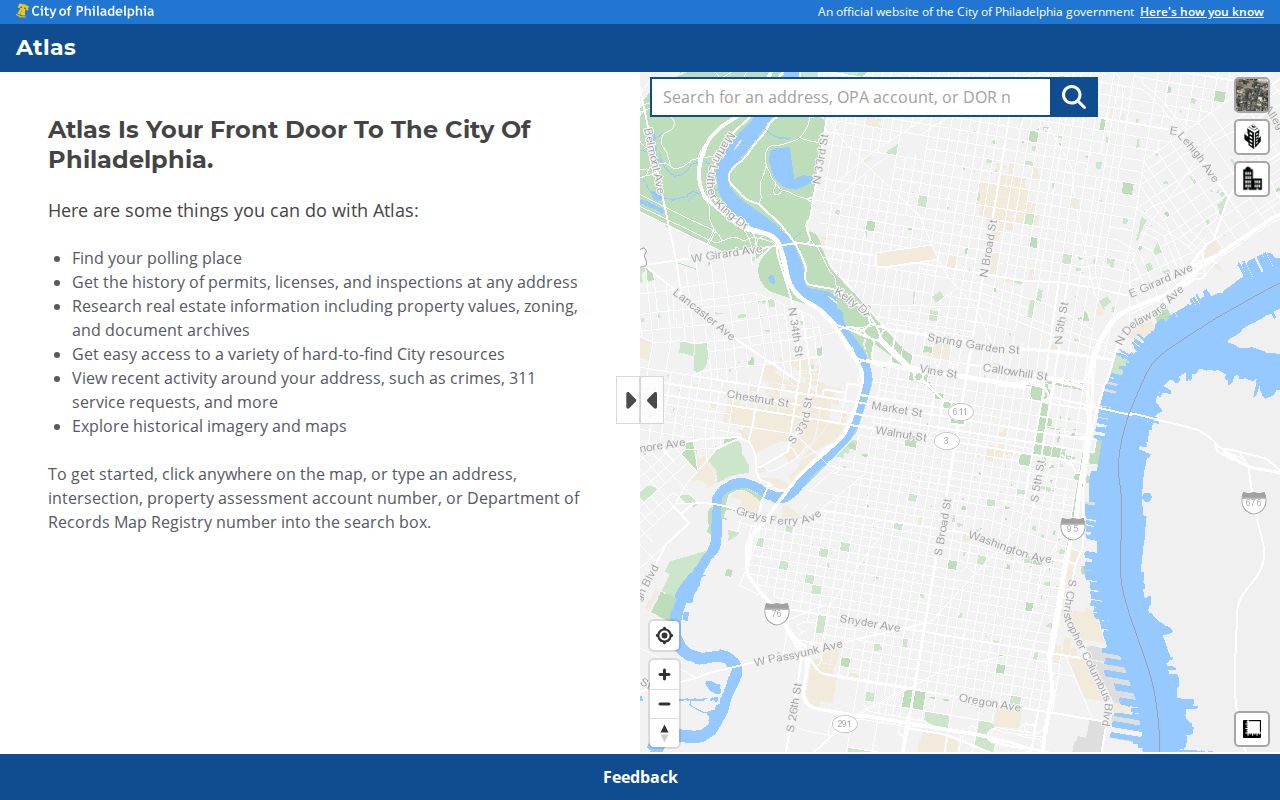
Save the address exactly as entered and note the parcel identifiers before moving to a permit, deed, or historical source. That small record trail helps distinguish a changed street form from a missing result.
Philadelphia Deed Search Has a 1974 Divide
Philadelphia land research has a clear modern and historical split. Philadox provides online deed and recorded-document searching from 1974 to the present, with document information and watermarked copies online. Printing documents or indexed information requires a paid subscription. For an earlier link in a title trail, City Archives lists Philadelphia County deeds from 1683 to 1955 and mortgages from 1736 to 1963. The dates overlap, but overlap does not mean every older record is searchable in the same way.
Use the current transaction to identify a grantor, grantee, recording date, document number, and legal-description clue. Then search a seller's earlier acquisition as a grantee when working backward. A deed party is evidence of a recorded transaction, not proof that the person currently lives at the property.
Philadelphia's long deed trail begins in 1683, while the online Philadox path begins in 1974. That is a records story, not a continuous digital index. The Department's document-copy channel can help when a requester has a known document reference.
| Philadelphia source type | What it is good for | What still needs checking |
|---|---|---|
| Official custodian record | It identifies the office, record class, date, and a route for a copy, correction, or access question. | Its own stated scope, restrictions, record image, and the distinction between party, owner, and occupant. |
| Commercial people-finder category | It may suggest a lead assembled from mixed sources. | Identity, currency, source provenance, and every fact against the official custodian record. |
Note: A recorded name match should be checked against the document image and custodian before it is treated as a title conclusion.
Current Philadelphia Resident Directories and Rolls
No current Philadelphia resident directory lists every household. Instead, current sources reveal narrow public relationships: an assessment record identifies a parcel and assessed ownership context, a recorded document identifies parties, and a court docket identifies public case participants. Registration confirmation is designed for the voter whose details are entered. A controlled voter-list request has its own statutory limits. Use the result as a lead, then test it against an independent record key.
| Philadelphia source | What it can establish | Custodian | Access boundary |
|---|---|---|---|
| Property App or Atlas | Parcel identity, assessment context, sales and property facts | Office of Property Assessment / City GIS | Address, account, or map identifier, not a name-based owner list. |
| Philadox | Parties to recorded land documents | Department of Records | 1974+ online path; a party is not necessarily a current resident. |
| UJS Case Search | Public docket party, case number, status, and event trail | Pennsylvania Unified Judicial System | Restricted, juvenile, expunged, and limited-access material does not display. |
| Voter status or list request | Individual registration confirmation or specified controlled fields | Department of State / City Commissioners | Status tool is not a browser; list rules and certification apply. |
| Register of Wills | Marriage-license or estate event clues | Register of Wills / Orphans' Court | Event evidence, not a current-location result. |
| Free Library directories | Published historic name, address, occupation, or reverse listing | Free Library of Philadelphia | Publisher gaps and listing limits require corroboration. |
Official custodians keep records with a stated scope and correction route. Commercial people-finder products combine sources that may be stale or mismatched and do not replace an official document, docket, or archive entry. Where a same-name issue matters, compare the address or parcel account with a deed reference, or compare a court number with the court and event date.
Philadelphia Voter Searches Have Tight Controls
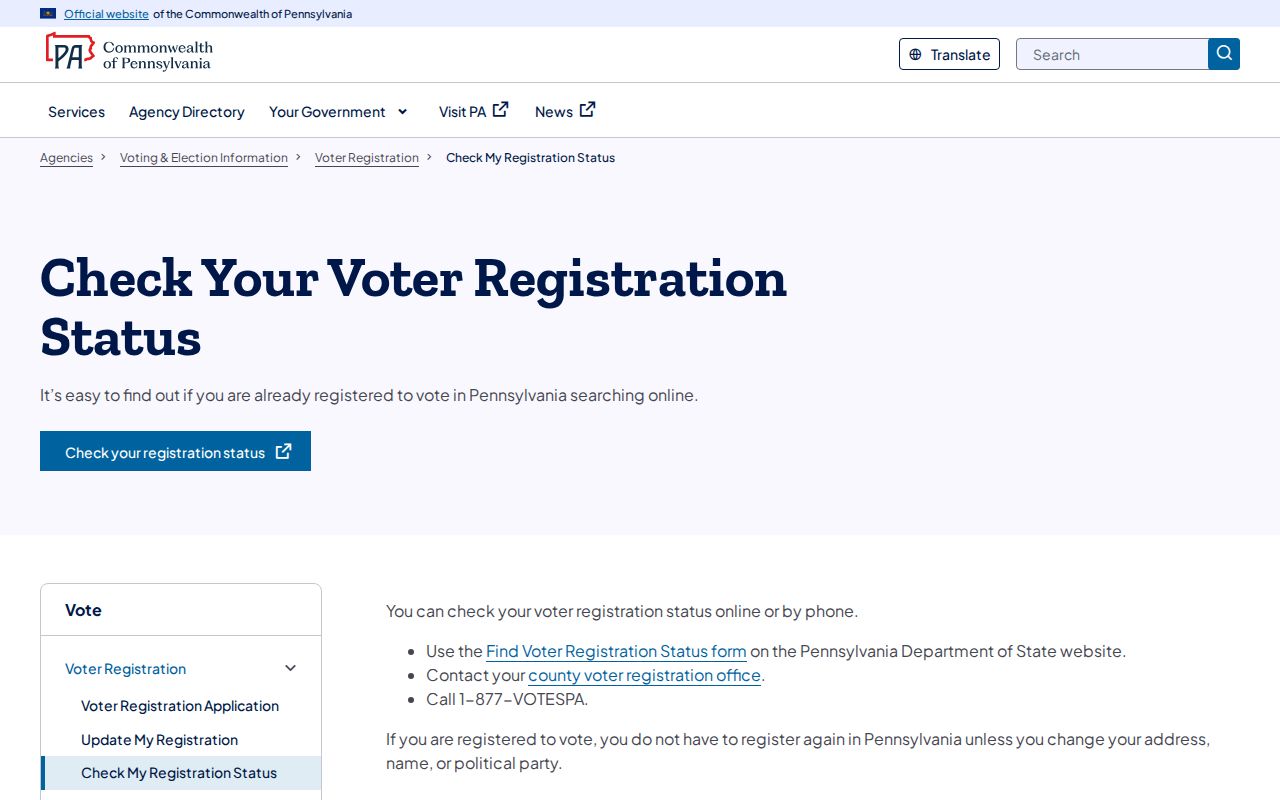
Pennsylvania's status tool confirms an individual registration when the person supplies identifying details. It is not a browseable Philadelphia residents directory or neighborhood map. The official route documents first name, last name, date of birth, county, and ZIP as inputs. Philadelphia's 66 wards and 1,703 divisions make election geography precise, but that detail does not convert the individual tool into a street search.
- First and last name: the individual-status form begins with a text identity match.
- Date of birth: the form uses it to distinguish same-name registrations.
- County and ZIP: Philadelphia County and the delivery ZIP provide local context.
- List type and county: a separate request form distinguishes public-information, street, walking, and full-export products.
- Use-restriction affirmation: a list request requires the form's statutory certification and identity details.
The official voter-status form is built for individual confirmation rather than open browsing.
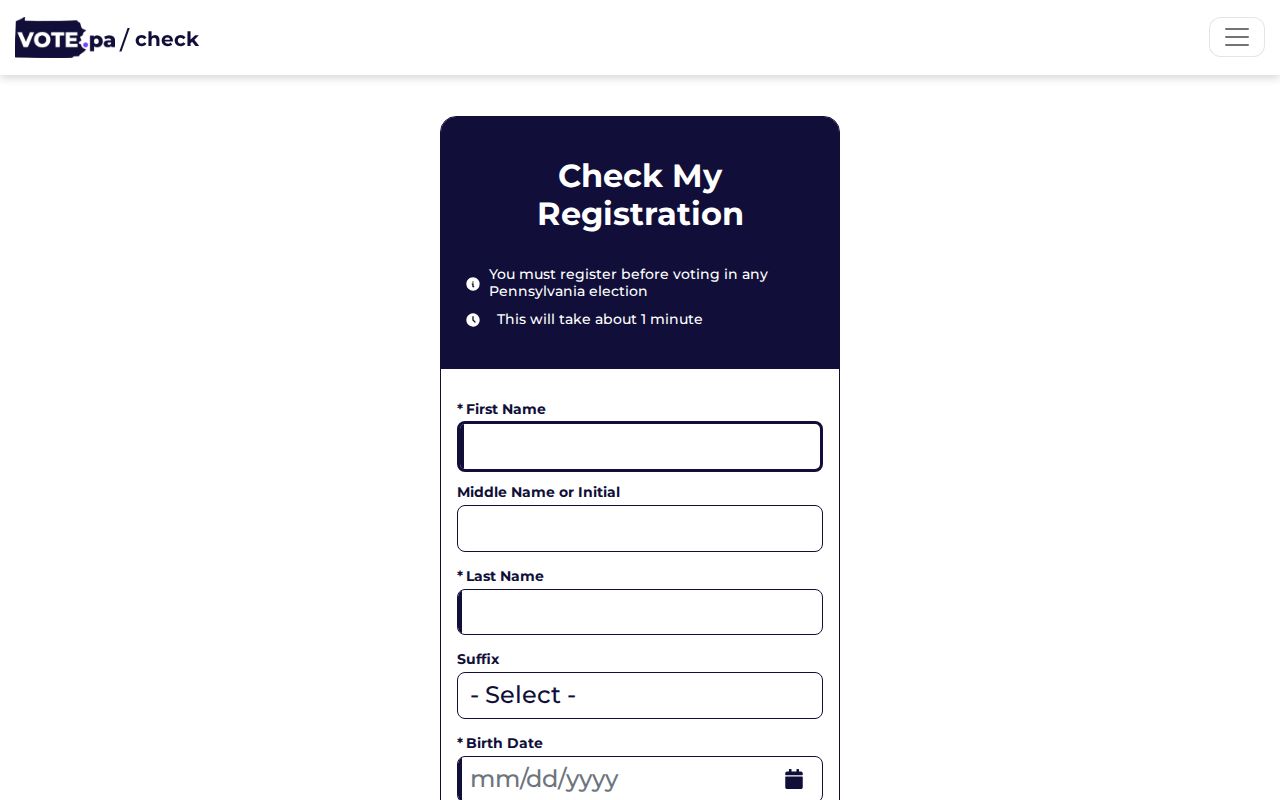
A status result can provide registration and related polling-place context, but it never reveals ballot choices. Inactive status is a maintenance field, not proof that a person moved or died.
The state instructions for checking registration also direct voters to their county office when they need assistance.
The separate voter-list request form describes public-information, street, walking, and full-export products, along with identity and certification requirements. It is not permission to publish a list of Philadelphia neighbors online.
Note: Electronic signatures and SURE numbers are excluded from the voter information that Pennsylvania makes available under its stated rules.
Philadelphia Court Dockets as a Name Check
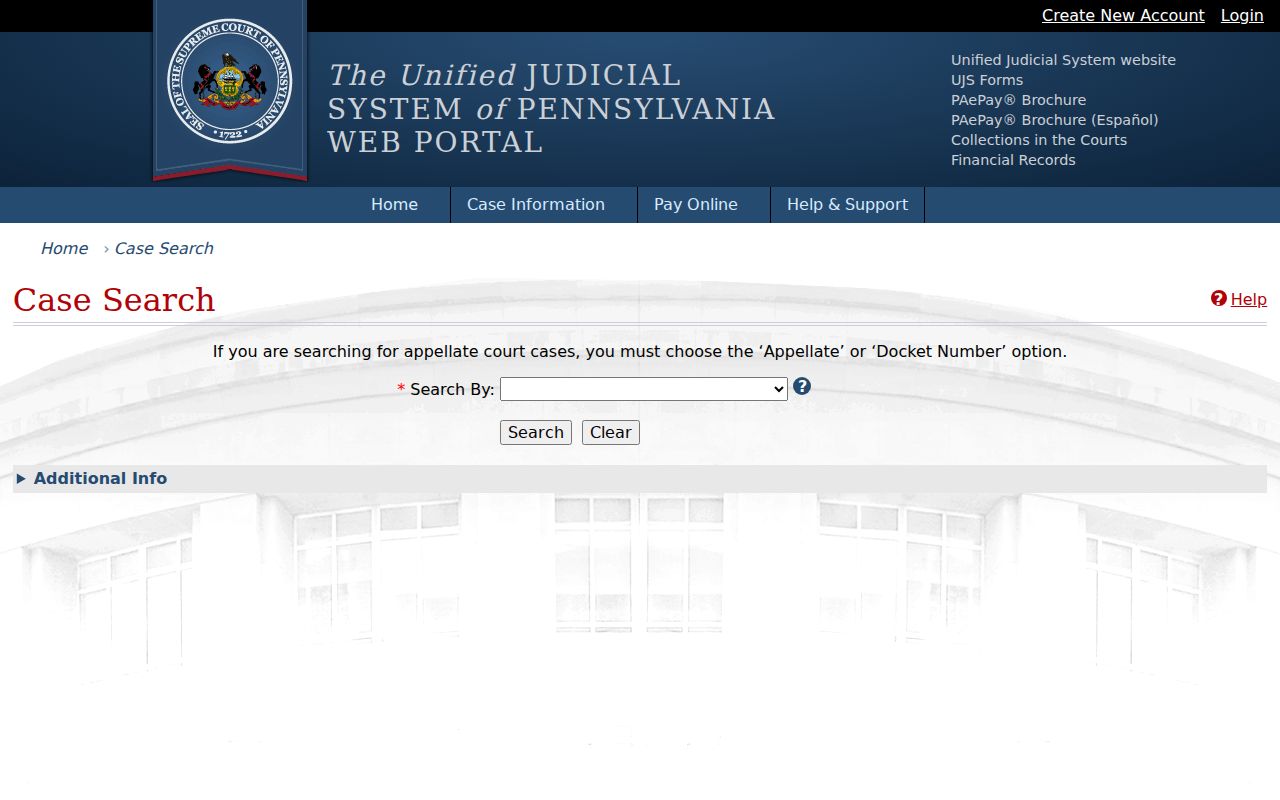
Pennsylvania UJS Case Search supplies public docket sheets statewide and can return applicable Philadelphia Municipal Court and Court of Common Pleas matters in an other-criteria search. A participant search can use a last name with optional first name and date of birth, then narrow by county, court, filing dates, case category, status, or role. Date of birth is not tracked reliably in every case, so a matching name alone is not enough to establish identity.
The Pennsylvania UJS Case Search displays advanced criteria for public docket research.
For a felony-related matter, inspect the Philadelphia cross-court docket number because a Municipal Court docket and Common Pleas docket can concern the same event. Juvenile, expunged, limited-access, and other restricted case material may not appear. A no-hit means no publicly displayable match for that query, not a legal clearance or a conclusion about a person.
Philadelphia Family Events and Estate Records
Marriage and probate records are useful event checks when the question involves family history, an estate, or a recorded life event. The Philadelphia Register of Wills holds marriage licenses from 1885, and its online name results cover 1995 or later. Older Philadelphia marriages, from 1860 to 1885, fall in the City Archives range. A Register marriage result can show available applicant names, license number, and license date, but it does not establish where either person lives now.
For estates, the Register's request route asks for a decedent's complete name at death, date of death, and requested record type. Mail research has a published $20 fee and a typical 7 to 10 business day response after staff receive the request. Non-impounded records are public, yet some files remain restricted. That makes probate a focused estate channel, not a broad resident listing.
The Pennsylvania Department of Health Division of Vital Records explains current birth and death certificate channels and eligibility.
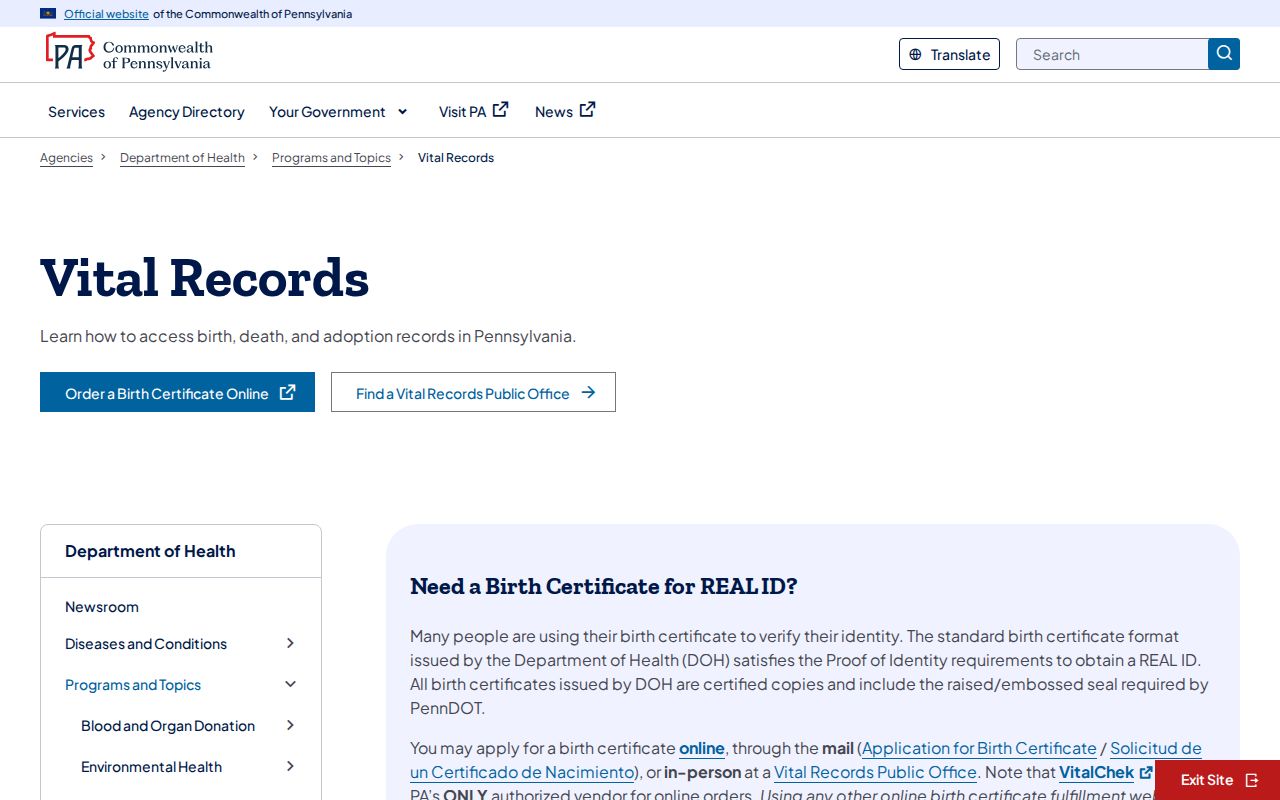
For historical research, the statute opens births after 105 years and deaths after 50 years to the State Archives for non-certified copies. The Department of Health remains the route for certified current certificates, and Philadelphia City Archives holds municipal groups for earlier periods.
Philadelphia Birth-Family Records Stay Confidential
Pennsylvania’s PAIR program is the official route for adoption and birth-family questions that need a confidential, consent-driven process. It supports contact preferences, medical and social history, and a confidential intermediary process. PAIR is not an open name-search system, and a missing result cannot be overcome by a wider address or directory search.
Eligible adoptees and lineal descendants may seek a non-certified original birth record under Act 127 of 2016 through the applicable official route. The research record notes a $20 fee, a stated 45-day time frame, and a birth-parent redaction option. Keep the request within that route and respect every contact preference and confidentiality limit.
Philadelphia Street Changes Affect Old Addresses
Old Philadelphia addresses need geographic context before a modern parcel search begins. The City’s Historic Streets Index traces historic and current street-name changes using road records, docket books, jury decisions, and surveys. The 1854 consolidation also created a numbering break. An address printed before that change can look wrong when it is entered unchanged in a current property system.
The Free Library’s 1898 and 1910 directory conversion tables offer a second bridge. Preserve the old address exactly as printed, note its later conversion separately, then use the current form in OPA or Atlas. Market and Front Streets work as standard numbering dividers, but Germantown and diagonal or creek areas have documented exceptions. A neighborhood name helps orient research, while the official street and parcel label controls the record search.
City Archives Extend Philadelphia Resident Research
When a modern portal ends, Philadelphia City Archives provides a defined historical fallback. Its holdings include deeds from 1683 to 1955, mortgages from 1736 to 1963, building permits and plans from 1889 to 1986, city directories from 1785 to 1936, and municipal vital groups for specified dates. Permits have no index for 1889 to 1905, so that time span should remain an identified access gap rather than be treated as fully searchable.
City Archives is at 548 Spring Garden Street, Philadelphia, PA 19123, open weekdays 8:30 a.m. to 4 p.m., with published contact 215-685-9401 and archives.info@phila.gov. Bring a focused record group, date range, address form, or document clue. An archive visit or inquiry works best when it requests a defined holding, such as an old deed, directory year, permit group, or cemetery return, rather than an improvised search for a person.
- Parcel
- A defined piece of land or property record, commonly linked to an OPA account or map identifier.
- Index
- A finding tool that points to a record; it is not always the record image or certified copy.
- Grantor and grantee
- The parties named in a recorded conveyance, commonly the transferring party and receiving party.
- Criss-cross directory
- A reverse address directory that runs from street and number to a listed party rather than from name to address.
Keep the record's original address and spelling in notes. Historic street changes and numbering changes can create a false gap if an old directory form is silently replaced with a modern one.
Note: Archive holdings describe what a record group contains; they do not promise that every volume has a searchable online image.
Historical Philadelphia Resident Directories at the Library
The Free Library's directory resources make Philadelphia's published resident trail unusually deep. City directories were published from 1785 to 1935 or 1936, depending on the holder's description, and Parkway Central has microfilmed directories by Boyd's, Polk's, Gopsill's, and others for 1832 to 1931 with annual gaps. A printed volume generally reflects the preceding year. Typical entries give a listed name, street address, and occupation, while some years add useful household clues.
Philadelphia's later reverse-address tools fill part of the gap after the city-directory era. The Free Library lists address telephone directories for 1927 to 1969 and Cole's Cross Reference Directory for 1973 to 2007. Cole's runs streets alphabetically and addresses numerically, usually with a listed name, phone number, and time at address. Those are published listings, not proof of every household member or an exact move date.
The Free Library directory-resources collection identifies the local holdings and its reading aids. The 1898 and 1910 directory conversion tables can help reconcile former and current street names before a present-day address search fails.
Philadelphia RTKL Requests Seek Existing Records
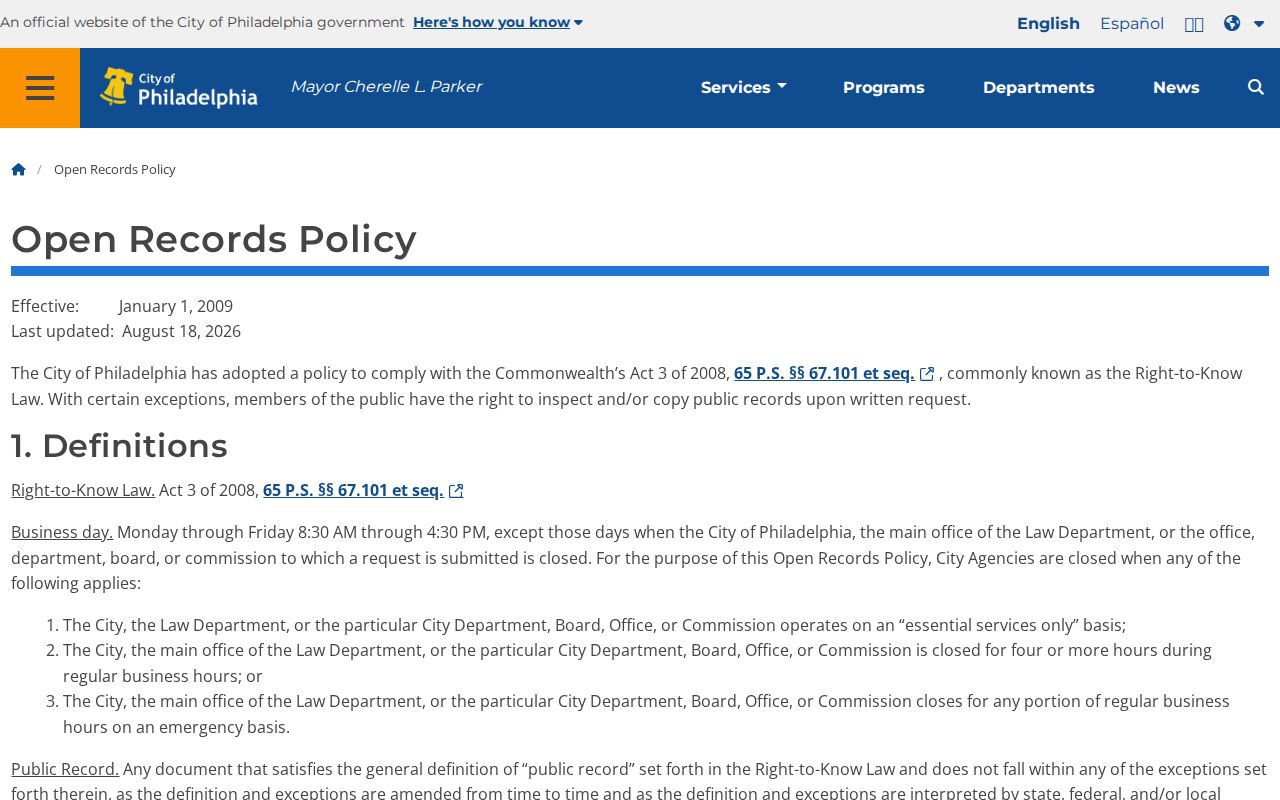
Pennsylvania's Right-to-Know Law, Act 3 of 2008, is the written fallback for existing City-agency records that are not already posted. Philadelphia accepts a non-anonymous written request in person, by mail, fax, or email. Describe the existing record and a meaningful time range. An agency does not have to create a custom list of people at an address, and a verbal or anonymous request does not trigger the regular process.
The Philadelphia Open Records Policy gives the City’s submission guidance for RTKL requests.
The normal response baseline is five business days unless the law's extension process is used. RTKL does not override sealed court files, restricted vital records, protected addresses, juvenile or adoption records, or private utility and driver information.
Protected Philadelphia Addresses Set Firm Limits
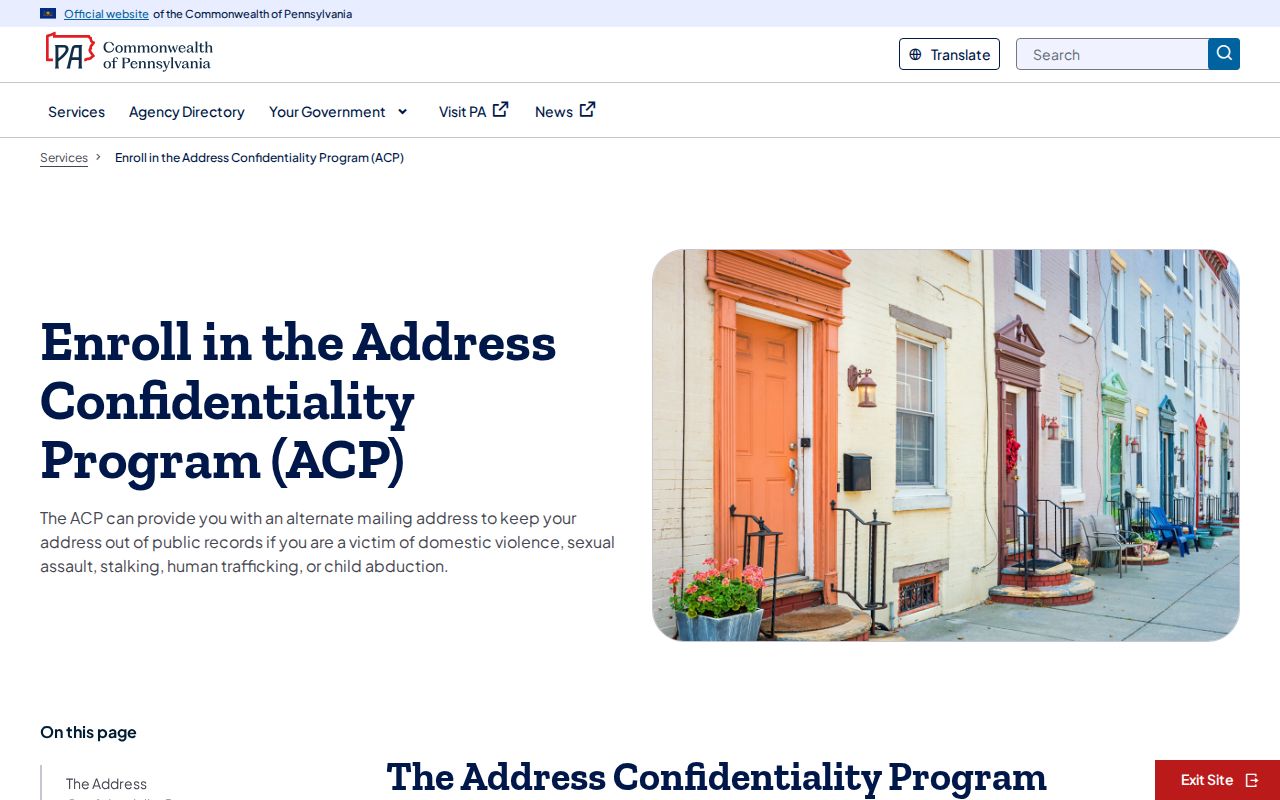
Some missing results are meant to remain missing. The Pennsylvania Address Confidentiality Program gives qualifying survivors a substitute mailing address for listed records, including voter registration and certain court, vehicle, school, marriage, and utility records. It is part of a safety plan and requires renewal every three years. It does not erase every independently public historical item, but it does mean a no-result must never be treated as an invitation to infer or reconstruct a private location.
The Pennsylvania Address Confidentiality Program describes the program’s eligibility and enrollment routes.
Corrections belong with the custodian. Use OPA's inquiry process for a property issue, the filed court for a public-access or redaction question, and the originating agency for an active record. Careful research uses the smallest amount of personal detail needed to verify a record.
Note: Pennsylvania harassment and stalking laws apply to conduct after a lookup as well as to direct contact.
New Philadelphia Records Safeguards and Digitization
Philadelphia's records system continues to change, so the access date belongs in every research note. On September 4, 2025, the Department of Records announced automated checking of whether a grantor was alive when a deed was signed. A record showing death before signature is rejected unless proof supports a correction. The control is an anti-fraud review step, not a substitute for title review, document inspection, or professional advice on ownership.
Later in September 2025, the Department announced a Philadox upgrade intended to ease property, deed, and ownership research, alongside card acceptance for many in-person services. In March 2026, City Council Finance Committee testimony described a planned partnership to scan, index, and host roughly one million historical birth, death, marriage, naturalization, and property records. The plan estimated about two years and proposed free access at archives, City Hall, libraries, and schools. It remains an initiative, not completed digitization.
Check the live custodian notice before paying a fee, arranging a visit, or assuming an interface still uses the same fields. Philadelphia's deep archive trail, current address tools, and new fraud controls are strongest when a search log keeps the source, date, document reference, and unresolved boundary together.