
Philadelphia Resident Lookup Records
A one-person verification works best as an evidence ladder. Each official record answers a narrow question: a parcel tool connects an address to property context, a deed names a party to a recorded document, and a court docket reports public case activity. Marriage, probate, vital, and voter sources each have their own access rules. No single result establishes current residence, identity, or every person at an address. Use two independent record keys before treating two same-name results as one person.
| Record | What It Confirms | Where | Access |
|---|---|---|---|
| Property record | Parcel owner or assessment context for a known address | Philadelphia Property App and Atlas | Free address-led tools |
| Recorded deed or mortgage | Named party and title-sequence clue | Philadox, or City Archives for earlier land records | Online index from 1974; archival route earlier |
| Public court docket | Party, case number, status, and public events | Pennsylvania UJS Case Search | Free public docket sheets, with exclusions |
| Marriage or probate record | Named applicants, license facts, decedent, or estate clue | Philadelphia Register of Wills | Index, counter, mail, and copy rules differ |
| Birth or death record | Recorded life event within date and eligibility limits | Pennsylvania DOH, State Archives, or City Archives | Custody and public access change by date |
| Voter source | Individual registration confirmation or controlled list fields | State status tool and authorized request form | Not a public neighborhood browser |
Start with the record that matches the fact in hand. A known current or former street address can be normalized in Property App or Atlas, then compared with a recorded document. A docket number belongs in UJS. A marriage date belongs in the Register’s channel. A death date belongs in the probate and vital routes. The order matters because it prevents a similar name from carrying the whole conclusion.
Philadelphia Resident Lookup Needs Two Keys
Philadelphia’s Property App deliberately has no owner-name search. Its documented entries are street address, OPA account number, Department of Records map-registry number, map click, nearby radius, drawn boundary, and a block: address query. That design makes it useful after an address is known, but it cannot turn a person’s name into a citywide owner list. Atlas supplies address, intersection, OPA-account, and map-registry context around the same physical place.
Keep the source-specific pairs intact. A parcel address and deed document number can support a recorded-property trail. A court number, court, participant role, and filing date can identify the correct docket. Marriage applicant names and a license date or number belong together. A probate request requires the decedent’s full name at death and death date. The key is to verify a fact against the custodian that created it, not to infer residence from an owner, party, or credential.
The historical side is separate. A directory listing can give an old name, address, and occupation, but it confirms a printed listing rather than present location or all occupants. When the question becomes an older household trail, the Philadelphia city directory collections provide the proper shelf and year-by-year method.
Philadelphia Court Records Fields
The statewide UJS Case Search is the official public docket route for Philadelphia Municipal Court and Common Pleas matters. A Philadelphia “other criteria” search can return applicable MC and CP cases. A felony may produce an MC docket and a later CP docket for the same event, so the Philadelphia cross court docket number should be checked before treating two numbers as separate records. Recent filing-office activity may not appear at once, and a public docket is not a complete court file.
| Participant name | Last name, optional first name, and date of birth can narrow a name-led query. |
|---|---|
| County and court | Select Philadelphia and the applicable judicial or court criteria when known. |
| Docket or citation number | Use the direct number route when a number is available. |
| Date filed | Start and end dates use the portal’s month/day/year format. |
| Case filters | Docket type, category, status, role, and calendar controls narrow results. |
| Address criteria | Parcel address, city, ZIP, county, and municipality fields appear where supported. |
The UJS help material describes the public search environment used for the screenshot below.
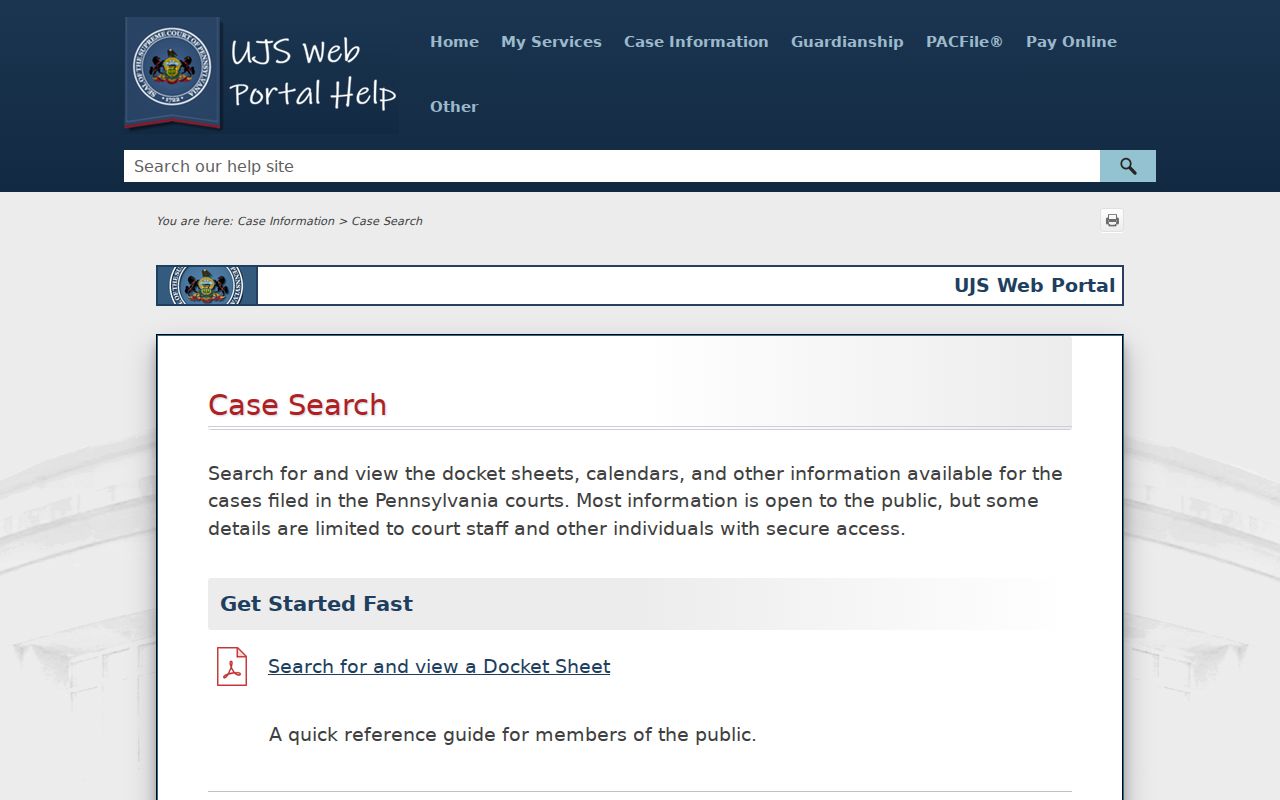
The UJS screen supports a fielded public-docket search, while certified records and nonpublic material remain with the court or clerk that holds the file.
A public UJS docket may show docket number, court and county, category, case status, participant name and role, filed and event dates, calendar events, entries, payment-related information, and a Philadelphia cross-court number where applicable. Juvenile, expunged, Act 5 limited-access, and other legally restricted matters may not display. A no-hit therefore means no publicly displayable match for that query, not a clearance or proof that no court record exists.
Philadelphia Resident Marriage Checks
The Register of Wills marriage route separates a public index lead from a copy request. Philadelphia marriage licenses date from 1885 at the Register, and online name results cover 1995 forward. The result can provide applicant names, license number, and date. It is event evidence, not a current-address finding. Records from 1860 to 1885 follow the City Archives route instead.
For a mail search, provide names used by both applicants, a marriage date if known, and a self-addressed stamped envelope. The Register lists a $15 mail research fee, then the record fee if the license is located. Certified copies are listed at $25, exemplified copies at $50, and same-day service at $45, subject to the office’s current instructions. A counter request is available at City Hall Room 415, and the online index remains the first step for the 1995-plus period.
For an estate question, the probate-record request route requires the decedent’s complete name at death, death date, and the record type sought, such as a will or inventory. Mail requests include a $20 research fee and return envelope; the Register lists counter service in Room 180 and a typical seven-to-ten-business-day response. Impounded records remain unavailable. Note: A marriage license or estate file can corroborate a dated event but does not identify a living person’s address.
Verify a Philadelphia Resident Lookup
A defensible one-person check tests the most specific facts in a deliberate order. The goal is not to collect every available result. It is to decide whether the name, place, date, and record really connect. Keep each search result with its exact search terms and access date. If the first official system has no result, use the documented fallback for that record type instead of switching to an unrelated source.
- Anchor the person to a lawful record key, such as a known address, account number, docket number, marriage date, or death date.
- Use the matching official index, then record the returned number, date, court, parcel, or license detail.
- Run a second independent official check that shares a stable fact, such as a deed document, court role, applicant pair, or decedent date.
- Request a copy only from the custodian when the remaining question requires the record image or certification.
- Stop when the record is restricted, sealed, impounded, or protected; a missing result is not an invitation to infer a location.
- Docket
- The court’s numbered case record, which identifies a matter and its public events.
- Index versus image
- An index points to a record; the actual scanned or paper record may have a separate access or copy process.
- Certified copy
- A custodian-issued copy that carries the office’s certification and is obtained under that office’s rules.
For a City-held existing record that is not online, the Pennsylvania Right-to-Know Law can be a written-request fallback for a described agency record. It does not override sealed court files, restricted vital records, protected addresses, or other exemptions. Philadelphia’s Open Records Policy requires a written, non-anonymous request and states a five-business-day response baseline unless an extension is used.
Philadelphia Resident Records by Date
Date and record type control the vital-record route. Philadelphia City Archives holds municipal birth and death records from July 1, 1860 through June 30, 1915. Pennsylvania Department of Health records run from 1906 to the present, while the State Archives serves the historical-public side. Under 35 P.S. § 450.801, birth records become public 105 years after birth and death records 50 years after death. Historical copies from the Archives are non-certified; a certified current record comes through DOH and its eligibility process.
The Pennsylvania genealogy vital-records guide explains the public-threshold and custodian split.
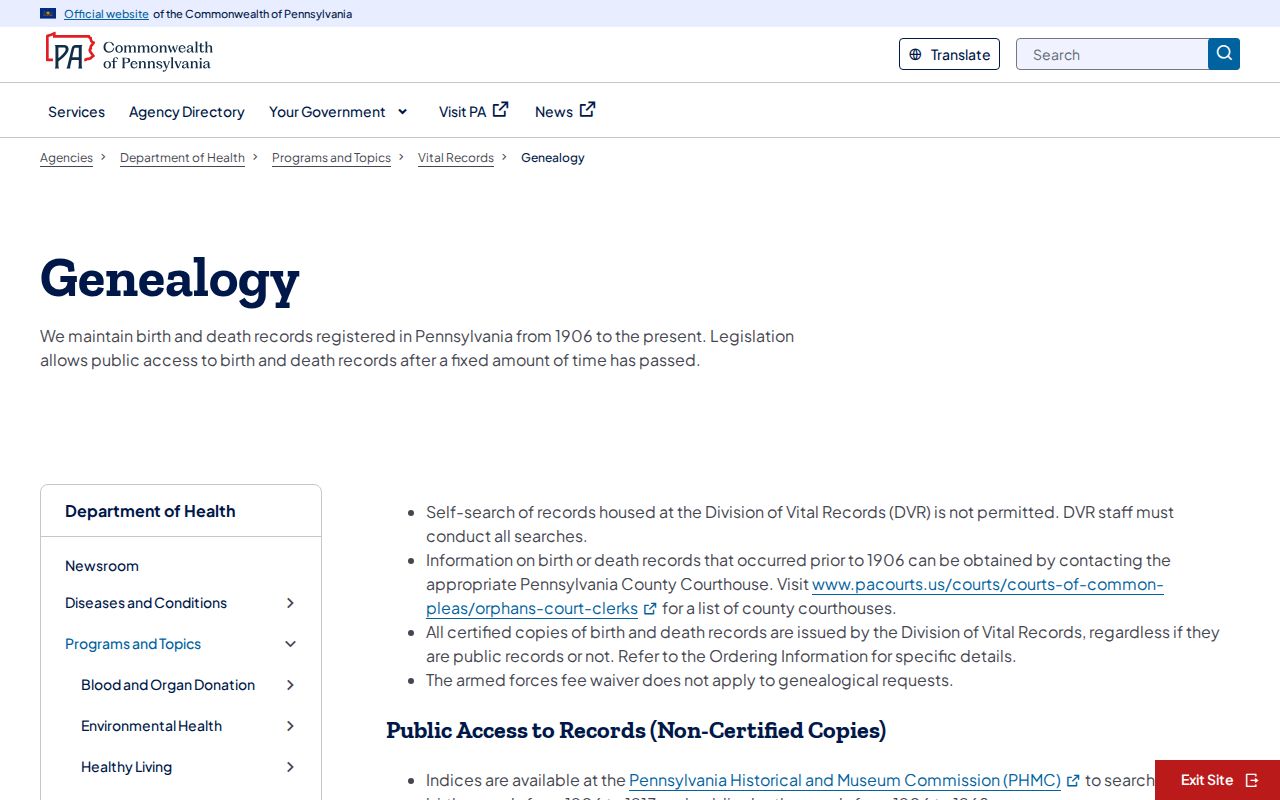
The guide leads historical requests to the appropriate archive path, while certified birth and death copies remain subject to the Department of Health’s current eligibility and form rules.
DOH says its staff conducts genealogy searches rather than allowing self-search of Division records. Its cited multi-year genealogy search is $45 for ten years, plus $25 for each additional ten-year period, and each name variation requires a separate application. The State Archives identifies original births from 1906 to 1920 and deaths from 1906 to 1975 in its historical materials. Earlier Philadelphia evidence may require the City Archives, cemetery returns, churches, newspapers, or family sources. The State Archives specifically reports no 1852–1854 returns for Philadelphia County in the state group.
Philadelphia Resident Lookup Voter Boundaries
Pennsylvania’s Find Voter Registration Status is an individual confirmation tool, not a way to browse a block. The documented inputs are first name, last name, date of birth, county, and ZIP. A voter can also use the state’s phone support or contact Philadelphia’s Voter Registration Office. Its result supplies registration confirmation and related official context, not ballot selections and not proof that a person presently occupies a particular address.
Controlled voter-list products have tighter rules. The state request form offers public-information, street, walking, and full-export products, with fields and access depending on the product. The form requires identification and a statutory certification, and it bars commercial or improper use and Internet publication. Electronic signatures and SURE numbers are excluded. An active or inactive designation is a registration-maintenance field, not proof that someone moved, died, or still lives at a location.
Philadelphia Resident PAIR Route
For adoption or birth-family questions, Pennsylvania’s PAIR is the official confidential route. It is consent-driven and is not an open name search. The program supports contact preferences, medical and social history, and a confidential intermediary process. This preserves a path for eligible people while respecting a birth parent’s stated contact preference and the limits of protected adoption records.
The official PAIR information is the source for the confidential process shown below.
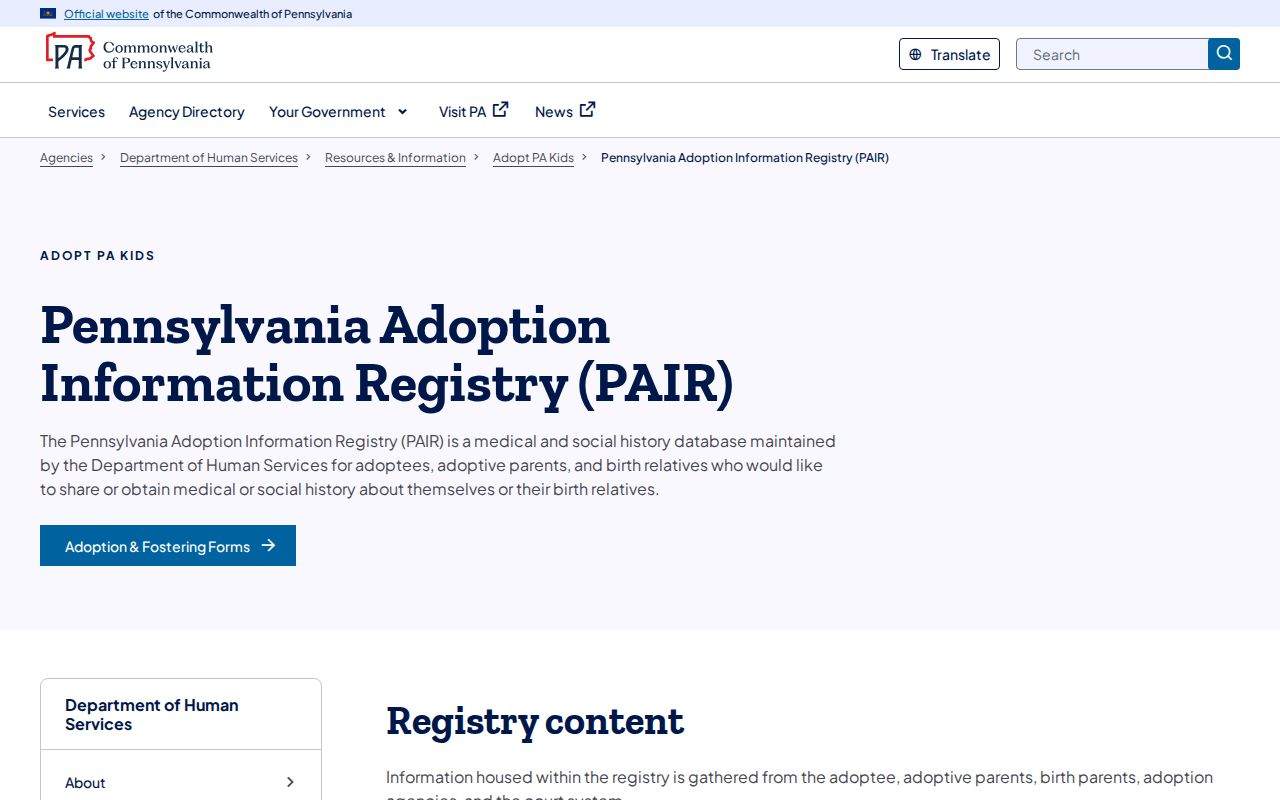
PAIR is a consent-based official channel, not an alternative way to search a private address or bypass a sealed record.
Eligible adoptees and lineal descendants may seek a non-certified original birth record under Act 127 of 2016 through the official route, which cites a $20 fee and a 45-day timeframe, with possible birth-parent redaction. PAIR can be reached at 1-800-227-0225. Use the current program instructions for eligibility and forms rather than assuming that an historical record or a similarly named person resolves a family connection.
Philadelphia Resident Lookup Privacy Limits
Some Philadelphia records are absent by law or design. Court policy withholds or redacts protected identifiers and restricted matters. The Driver’s Privacy Protection Act restricts personal motor-vehicle information. The RTKL requires agencies to withhold exempt personal and security information, and it cannot be used to erase a legitimate public record. If an official record is wrong, seek correction from the custodian that created it and retain the request confirmation.
The Pennsylvania Address Confidentiality Program, governed by 23 Pa.C.S. chapter 67, offers eligible survivors a substitute mailing address for listed voter, court, vehicle, school, marriage, utility, and other records. Enrollment is online or through a victim-service provider, and the program renews every three years. It does not guarantee removal of every independent historical record. A protected-address no-result must never be treated as a lead to reconstruct someone’s location.
Lawful use. Use official records only for lawful personal research. Pennsylvania’s harassment and stalking statutes, 18 Pa.C.S. §§ 2709 and 2709.1, still apply to conduct after a record is found; do not use any result to contact, intimidate, stalk, or harm another person.